
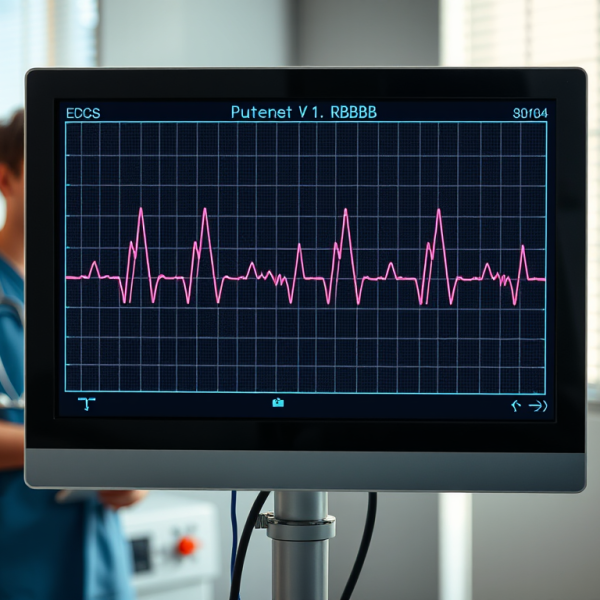
Right Bundle Branch Block (RBBB) is more common in older adults, often due to normal aging or heart disease. It can also occur in people with diabetes or those who have had a heart attack affecting the heart’s front wall. About 1% of people may have RBBB as a normal variant without any heart issues. Those without heart disease generally have a good outlook, but individuals with heart problems may face more complications.
Left Bundle Branch Block (LBBB) usually indicates serious heart issues and is associated with worse health outcomes. Diagnosing a heart attack (AMI) in someone with a bundle branch block can be complicated. LBBB hides the ECG changes linked to a heart attack, making diagnosis harder.
In contrast, RBBB does not complicate the ECG diagnosis of a heart attack. However, doctors who are not experienced with RBBB patterns may overlook signs of a heart attack. The modified Sgarbossa criteria, which assist in identifying a heart attack with LBBB, do not apply to RBBB.
To diagnose RBBB on an ECG, look for these signs:
– ST segment changes in lead V1, which should be depressed opposite the major part of the QRS complex.
In early STEMI, the J point will be elevated, and the ST segment will be elevated on the same side of the QRS complex.
– In established STEMI, both the J point and the ST segment will be elevated.

The QRS complex should be wider than 0.12 seconds, and a specific pattern must be seen in lead V1. The relationship between the QRS complex and the ST segment or T wave changes is important. In uncomplicated RBBB, ST segment and T wave changes usually appear on opposite sides of the baseline. Recognizing this helps avoid confusing RBBB with AMI.
Patients with STEMI and RBBB are at a higher risk of complications. About 6% of people with AMI have RBBB, though numbers vary. These patients often are older and have significant blockages in their coronary arteries. They may face severe problems like heart failure and low blood pressure during their hospital stay, leading to higher mortality rates.
Treatment for patients with AMI is generally the same as for those without RBBB. Urgent treatments like coronary intervention or clot-busting medication apply to STEMI. For NSTEMI, the treatment should depend on the patient’s overall condition. If RBBB is new, it indicates a higher risk, requiring prompt and aggressive treatment.
Pearls :
- Right bundle branch block (RBBB) does not interfere with the ECG diagnosis of ST-elevation myocardial infarction (STEMI).
- Understanding the anticipated ST segment and T-wave findings of uncomplicated RBBB is vital for recognizing early STEMI.
- Careful examination of the J point and the related ST segment is essential in patients with RBBB who are suspected of having an AMI.
- New-onset right bundle branch block (RBBB), in the context of an evolving ST-elevation myocardial infarction (STEMI), indicates an extreme risk comparable to the left bundle branch block (LBBB).
Winters, Michael E.; Woolridge, Dale P.; Marcolini, Evie; Lu, Mimi; Dubbs, Sarah B.. Avoiding Common Errors in the Emergency Department. Wolters Kluwer Health.