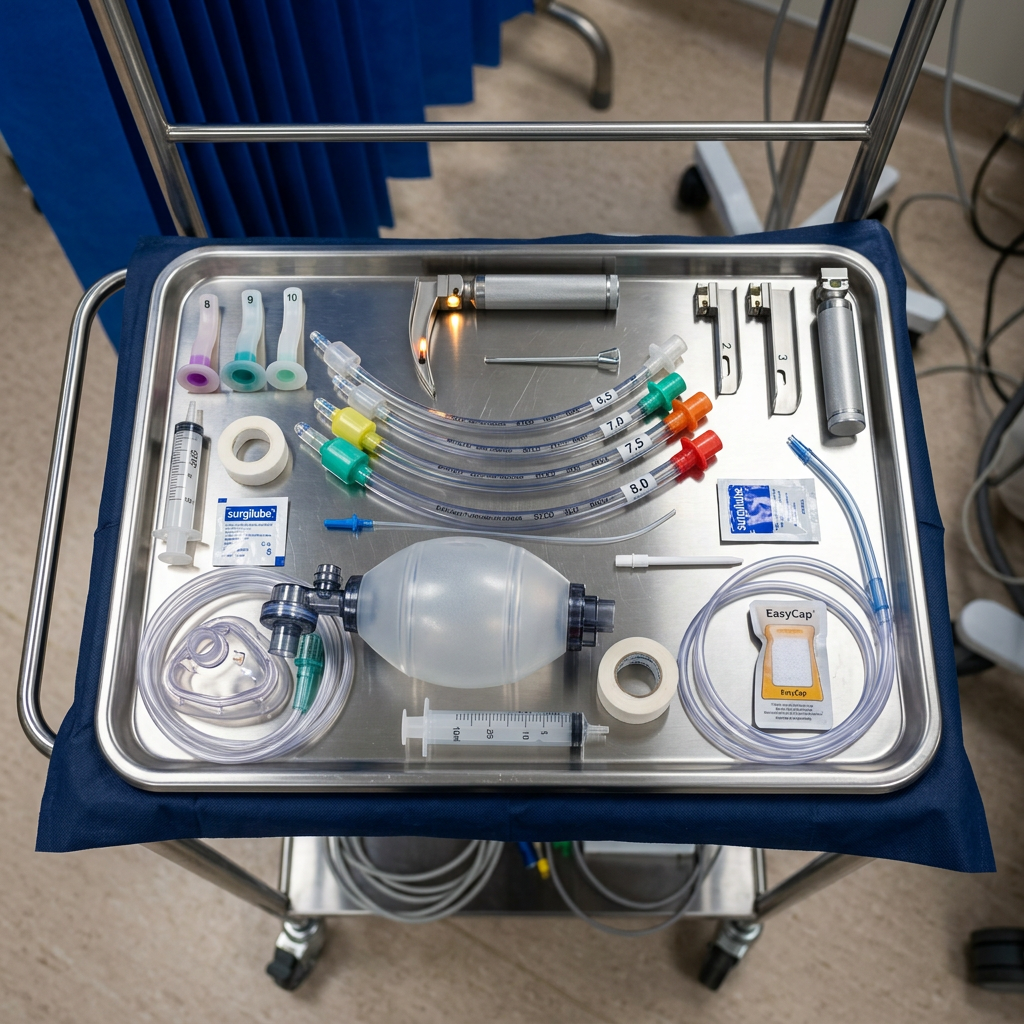
Emergency airway management is not simply a procedure. It is a physiologic transition under time pressure.
The common mistake is to think, “I need to place the tube.”
The expert mindset is different:
I need to preserve oxygen delivery while creating a secure airway.
That distinction matters. A tracheal tube is one way to oxygenate. A supraglottic airway can oxygenate. A two-person bag-mask technique can oxygenate. A front-of-neck airway can oxygenate when everything else fails.
The patient does not die because the tube is not in. The patient dies because oxygen delivery fails, circulation collapses, or rescue is delayed.
That is why modern emergency airway management should be taught as an oxygenation strategy, not an intubation attempt.
The airway plan is not Plan A. It is Plans A, B, C, and D.
The Difficult Airway Society’s 2025 adult unanticipated difficult intubation materials retain a stepwise structure: Plan A is tracheal intubation, Plan B is supraglottic airway device ventilation, Plan C is facemask ventilation, and Plan D is emergency front-of-neck airway. The DAS master algorithm also emphasizes oxygenation throughout, waveform capnography confirmation, declaring failure clearly, and limiting Plan A to a maximum of 3 + 1 attempts.
This is more than an algorithm. It is a mindset.
Before induction, the airway leader should say out loud:
“Plan A is tracheal intubation. If that fails, we move to Plan B: supraglottic airway. If that fails, Plan C is optimized two-person facemask ventilation. If we cannot intubate and cannot oxygenate, Plan D is front-of-neck airway.”
That short briefing prevents silence. It gives the team permission to move forward.
In emergency airway management, silence after failure is dangerous.
Start before the laryngoscope: identify the physiologically difficult airway
Traditional airway teaching focused heavily on anatomy: mouth opening, neck mobility, Mallampati, facial trauma, obesity, and airway obstruction.
That still matters.
But in emergency medicine and critical care, many catastrophic airways are not anatomically difficult. They are physiologically difficult.
The patient may have:
- severe hypoxemia
- shock
- metabolic acidosis
- right ventricular failure
- severe asthma or COPD
- pulmonary edema
- ARDS
- sepsis
- obesity with low functional residual capacity
These patients may be technically easy to intubate but still arrest during or after intubation.
Why?
Because induction removes sympathetic tone. Paralysis removes spontaneous respiratory mechanics. Positive-pressure ventilation increases intrathoracic pressure, reduces venous return, and can worsen right ventricular afterload.
So the key pre-induction question is not only:
“Can I see the cords?”
It is also:
“Will this patient survive apnea, induction, and positive pressure?”
DAS 2025 preparation materials specifically include assessment for physiologic difficulty, aspiration risk, available imaging, airway history, bedside airway assessment including the cricothyroid membrane, and a deliverable preoxygenation strategy.
Preoxygenation is no longer enough. Think peroxygenation.
Preoxygenation means oxygen before intubation.
Peroxygenation is broader. It means oxygen delivery before, during, between, and after attempts.
That is the modern mindset:
Do not give oxygen as a step. Maintain oxygen as a strategy.
A healthy patient desaturates when the oxygen reservoir is depleted. A critically ill patient desaturates because the reservoir is already small, shunt is high, alveoli are derecruited, and cardiac output may be unstable.
So oxygenation must match physiology.
A nonrebreather may be enough for a stable patient. But in pneumonia, ARDS, pulmonary edema, obesity, atelectasis, or severe hypoxemia, the problem is often not just oxygen concentration. The problem is alveolar collapse and shunt.
Those patients often need pressure: NIV, CPAP, BVM with PEEP, or high-flow nasal oxygen depending on the clinical situation.
The SCCM RSI guideline suggests head-and-torso elevation during RSI, HFNO when laryngoscopy is expected to be challenging, NIPPV in severe hypoxemia, and medication-assisted preoxygenation when agitation prevents adequate preoxygenation.
The bedside translation:
NRB gives oxygen.
NIV gives oxygen plus pressure.
In shunt physiology, pressure may be the lifesaving part.
DSI: the missing tool for the agitated hypoxic patient
One of the most dangerous airway patients is awake, hypoxic, delirious, and fighting the mask.
They tear off the nonrebreather. They cannot tolerate NIV. They are too agitated to preoxygenate, but too hypoxemic to safely paralyze.
This is where delayed sequence intubation, or DSI, belongs.
DSI is not “slow RSI.” It is medication-assisted preoxygenation. The usual concept is to give a dissociative dose of ketamine to calm the patient while preserving respiratory drive, then apply effective preoxygenation, then proceed to paralysis and intubation when physiology has improved.
The target patient is not every intubation. The target patient is the one who cannot cooperate with oxygenation.
DSI turns a combative hypoxic airway into a preoxygenated airway.
This is a major emergency medicine skill because the patient who cannot tolerate preoxygenation often has the smallest oxygen reserve.
Plan A: first attempt, best attempt
The first attempt is often the best attempt.
After a failed attempt, the airway is usually worse. Oxygen saturation falls. CO₂ rises. Secretions increase. Blood appears. Edema develops. The operator becomes stressed. The team becomes quieter.
So Plan A should not mean “just take a look.”
Plan A should mean:
Best operator, best position, best device, best oxygenation, best hemodynamics, best backup plan.
Video laryngoscopy has moved from “backup device” to a modern default in many ED and ICU airway systems. But video laryngoscopy is not one technique.
A Macintosh-style VL blade and a hyperangulated VL blade behave differently.
With a Macintosh-style VL blade, tube delivery is often more intuitive because the geometry resembles direct laryngoscopy.
With a hyperangulated blade, the view may be excellent but tube delivery may be difficult. The tube often needs a properly shaped rigid stylet, bougie, or flexible scope strategy. Seeing the cords is not the same as delivering the tube.
That is an important teaching point:
VL solves the view problem. It may create a delivery problem.
Bougie: ready, deliberate, not blind
The bougie is a powerful tool, especially with an anterior airway or limited glottic view.
But the bougie is not magic.
The dangerous misuse is blind advancement into a poor view. A bougie should not become a spear. Blind insertion into a grade 3 or 4 view risks trauma, false passage, or airway perforation.
A practical teaching phrase:
Use the bougie when you know where it is going. Do not use it to guess where the trachea might be.
The old “hold-up sign” should also be treated with caution. Forcing the bougie until resistance is felt can injure the airway. Tracheal clicks and controlled depth are safer than aggressive advancement.
RSI drugs: physiology first, pharmacology second
The wrong question is:
“Which induction drug is safest?”
The better question is:
“How much physiologic reserve does this patient have?”
Etomidate remains reasonable. Ketamine is useful, especially when hypotension or bronchospasm is a concern, but it is not magically hemodynamically neutral. In catecholamine-depleted shock, ketamine can still be followed by hypotension. Propofol and benzodiazepines can be dangerous in shock unless carefully dose-reduced.
The SCCM RSI guideline advises giving a sedative-hypnotic induction agent when a neuromuscular blocker is used, recommends neuromuscular blockade when sedative-hypnotics are used for intubation, and suggests either rocuronium or succinylcholine when succinylcholine is not contraindicated. It also found no clear difference between etomidate and other induction agents regarding mortality or peri-intubation hypotension/vasopressor use.
The modern rocuronium versus succinylcholine discussion also has a third player: sugammadex.
If sugammadex is immediately available, high-dose rocuronium becomes more attractive because reversal is possible. But that does not mean sugammadex is a rescue oxygenation plan. Reversal takes time, airway obstruction may persist, and evidence for routine ED reversal improving patient-centered outcomes remains debated.
So the cleanest message is:
Choose the paralytic deliberately. But never let “reversal is available” replace a real Plan B, C, and D.
And after rocuronium, remember the hidden danger:
Paralysis can hide suffering. Post-intubation analgesia and sedation must start immediately.
Hemodynamics: draw the vasopressor before induction
Many emergency airways fail after the tube is placed.
The anatomy was easy. The tube passed. Capnography appeared. Then the blood pressure collapsed.
This happens because intubation is not just airway management. It is a cardiovascular intervention.
Before induction in a shocked patient, prepare:
- fluid only if fluid-responsive
- vasopressor infusion early when appropriate
- push-dose vasopressor drawn up for rescue
- lower induction dose when physiology demands it
- post-intubation ventilator settings that avoid excessive intrathoracic pressure
Do not say “pressor available” if it is still in the medication cart.
Say:
“Push-dose vasopressor is drawn and labeled.”
That sentence changes behavior.
Plan B: supraglottic airway is not defeat
When Plan A fails, the next goal is not pride. The next goal is oxygenation.
DAS 2025 identifies Plan B as a supraglottic airway device, with a maximum of three attempts, use of a second-generation device, adequate neuromuscular blockade, confirmation of ventilation by waveform capnography, and a stop-think-communicate pause after oxygenation is restored.
This is a major cultural point.
An SGA is not failure. An SGA is oxygenation. Oxygenation is success.
Once oxygenation is restored, the team can decide: wake the patient, intubate through the SGA, proceed temporarily without intubation, or prepare for front-of-neck access.
But if the SGA fails, declare it clearly:
“Failed SGA ventilation. Open the eFONA kit. Move to Plan C.”
Plan C: facemask ventilation is not basic
Bag-mask ventilation is often described as a basic skill. In a crashing airway, it is an advanced resuscitation skill.
Plan C should be optimized:
- two-person technique
- thenar grip
- oral airway
- nasal airway when appropriate
- PEEP valve
- good head and neck position
- full neuromuscular blockade
- gentle ventilation with visible chest rise
- waveform capnography when available
The goal is not to squeeze harder. The goal is to seal better, open the airway, apply pressure intelligently, and oxygenate without insufflating the stomach.
A simple phrase for the room:
“Stop laryngoscopy. Oxygenate now.”
If Plan C works, pause and rethink.
If Plan C fails after failed intubation and failed SGA, the situation is no longer “difficult airway.”
It is CICO.
Plan D: CICO is not a discussion
CICO means cannot intubate, cannot oxygenate.
At that moment, the team does not need another laryngoscopy attempt. The team needs front-of-neck access.
DAS 2025 Plan D materials specify emergency front-of-neck airway with a size 10 scalpel, bougie, and 6.0 mm cuffed tube, continuing 100% oxygen to the upper airway, maximal neck extension when possible, full neuromuscular blockade, suction available, and confirmation of ventilation with waveform capnography.
The key operational detail:
Palpable cricothyroid membrane: scalpel–bougie–tube.
Impalpable cricothyroid membrane: vertical midline incision, finger dissection, then scalpel–bougie–tube.
A cricothyrotomy kit in the room is not enough.
A real Plan D means the team knows:
- who will cut
- where the membrane is
- what technique will be used
- what phrase triggers action
The trigger phrase should be simple:
“CICO. Front-of-neck airway now.”
POCUS belongs before the disaster
Ultrasound should not be considered only after CICO occurs.
In high-risk patients, use POCUS before induction when time allows to identify the cricothyroid membrane, especially in obesity, neck swelling, trauma, burns, prior radiation, or distorted anatomy.
The DAS 2025 preparation algorithm explicitly includes bedside airway assessment including the cricothyroid membrane.
The principle is simple:
Do not start looking for the cricothyroid membrane when the saturation is 40%.
Find it early. Mark it early. Then hope you never need it.
The airway script
Before induction, the team leader can say:
“This is a physiologically high-risk airway. Plan A is video laryngoscopy with suction ready and stylet or bougie prepared. We are using peroxygenation throughout. If the first attempt fails or oxygenation worsens, we stop and oxygenate. Plan B is a second-generation SGA. Plan C is two-person facemask ventilation with adjuncts and PEEP. Plan D is front-of-neck airway. Capnography is connected. Vasopressor is drawn. Post-intubation sedation is ready.”
That script takes less than 30 seconds.
But it prevents the most dangerous airway error:
repeating Plan A while the patient is dying.
Final take-home message
The modern emergency airway mindset is not:
“Can I intubate?”
It is:
“Can I maintain oxygen delivery through every phase of airway management?”
Optimize the first attempt. Oxygenate continuously. Recognize failure early. Change something after every failed attempt. Use SGA without shame. Master BVM. Prepare the neck before you need it. Cut early when CICO is declared.
The best airway clinicians are not the ones who never fail.
They are the ones who recognize failure early, protect oxygenation, and move decisively to the next plan.